MASTER DATA MANAGEMENT / DATA ARCHITECTURE
By Jørgen Guldmann · 24 November 2026 · 4 min read
Ask how many products the company sells and you will get three answers. The ERP counts materials, the webshop counts products and the retailer’s feed counts articles. Nobody is wrong, and none of the numbers match.
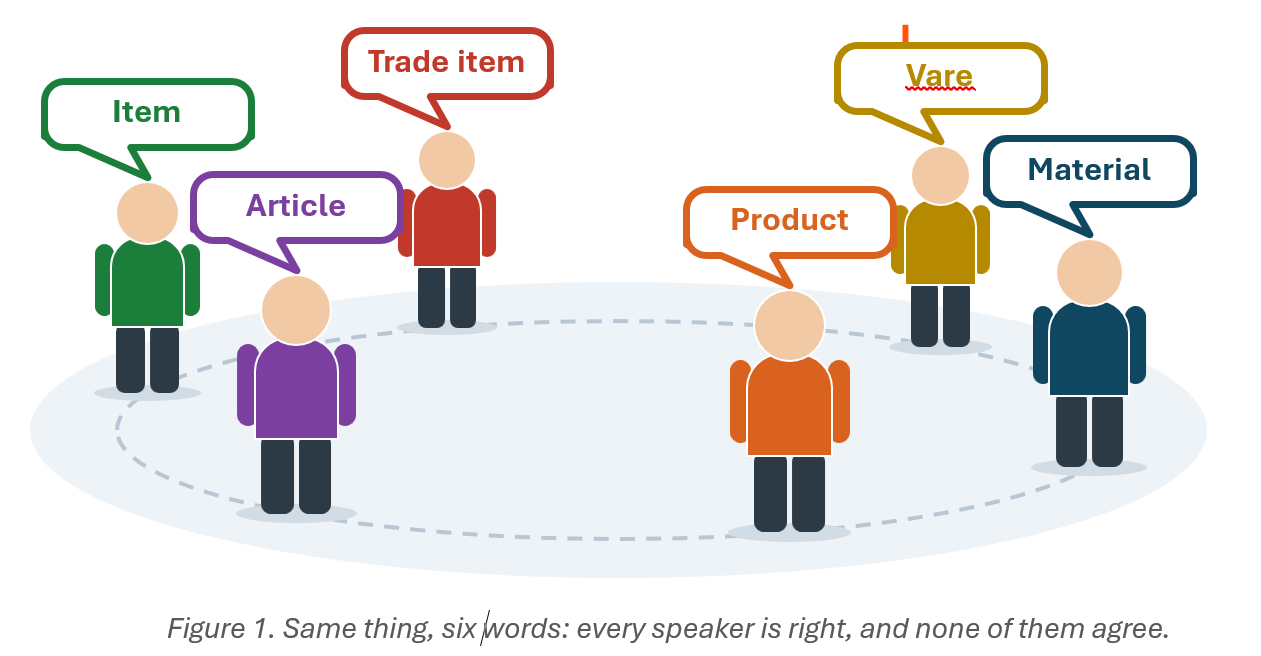
English gives us product, material, article and item for what is more or less the same thing. Every organisation I have worked with uses at least three of them, usually without noticing. Nobody decided this. It happened.
In brief
- The words are inherited from systems and standards, and each makes sense where it came from.
- The real trouble is that departments use one word for different levels of granularity.
- The cost lands in integration, reporting and regulation.
- The fix is to define the levels, assign each a canonical term, record the synonyms, and link the glossary to the data.
Where the words come from
Most of it is inherited. SAP calls the core entity a material, so anyone running SAP calls it a material, including people who have never opened SAP. The UPC says product. The European article number says article. Item is what ends up as a column header on the invoice because nobody could agree on the other three. Product often means the sellable thing, or the parent node with a handful of variants underneath.
The table below sets out the pattern. The meanings are typical, not universal.
| Term | Where you meet it | What it usually means |
|---|---|---|
| Material | SAP and other ERP systems | Anything that is procured, stocked or produced, often held per plant |
| Product | UPC, PIM and commerce platforms | The sellable offering, or a parent node with variants beneath it |
| Article | European Article Number (EAN), retail | The trade unit identified by a GTIN in European retail |
| Item | Order and invoice lines, some ERP systems | A neutral line-level word whose meaning depends on the system |
| Trade item | GS1 standards | Anything priced, ordered or invoiced in the supply chain |
Each use makes sense where it came from. Put them in the same meeting, and you get two hours of polite disagreement about what is actually being discussed.
What it costs
I see the bill in three places.
Integration
A mapping from “material” in the ERP to “product” in the PIM looks like a simple field mapping on the whiteboard. Then you find that one product is six materials, because colour, pack size and plant each got their own record. Nobody did anything wrong. The two words sit at different levels, and the mapping papered over it until a report double-counted or a catalogue showed the wrong variant.
Reporting
Count your products and count your materials. If the numbers are far apart, both can still be right. Without a definition on paper, someone will spend a week proving the other team wrong.
Regulation
The Digital Product Passport is tied to a particular level of identification, set by the rules for each product group. If you cannot say which of your entities sits at that level, you are starting with archaeology instead of compliance.
What I actually do
I keep it boring because boring works.
- Start with the levels, not the words. What does the business need to tell apart? The commercial offering, the variant that gets a GTIN, the unit on the shelf, and the thing that goes into production. Draw it, then write down who owns each level, when it is created, and which identifiers live there.
- Give each level one name. One. List the other words as synonyms and note which system uses which. SAP’s “material” is a synonym entry. It is not a competing definition, and nobody needs to feel bad about it.
- Put the glossary where people can find it. A Word document in a SharePoint folder gets read once, by the person who wrote it. A glossary in Microsoft Purview, linked to the real tables and columns in Fabric, is found when someone searches for the term or views the data. That is the difference between a glossary and a document about a glossary.
- Do it in the languages people actually speak. In Denmark that means “vare”, “artikel” and “materiale”, sitting next to the English terms, each with its own shade of meaning. Map them all to the same concept.
An illustrative hierarchy
The levels below are an example only. Your business may need fewer or more, and the owners will differ.
| Level | Question it answers | Typical owner | Identifiers and terms you will hear |
|---|---|---|---|
| Commercial offering | What do we sell, as a concept? | Product management | Product or model ID; “product”, “model”, “family” |
| Variant | Which version does the customer choose? | Product management | GTIN; “article”, “SKU”, “variant” |
| Stocked unit | What do we hold, and where? | Supply chain | Material number per plant; “material”, “item” |
| Production unit | What goes through production? | Manufacturing | Component or BOM number; “material”, “component” |
A quick test for your organisation
Before you build anything, try this in a 30-minute session.
- Pick five entities from your ERP and PIM, and ask three teams to place each one at a level of the hierarchy.
- Count the disagreements. Each one is a glossary entry waiting to be written.
- Ask who decides if the teams still disagree afterwards. If nobody can answer, that is the real finding.
Bottom line
There is no correct word. Your industry may lean one way, and it is worth following if it does. Beyond that, choose, write it down and connect it to the data.
If you cannot point to the page where “product” and “material” are defined in your company, you have just found your next governance task. It is a small one. Do it before the next workshop.
Leave a Reply