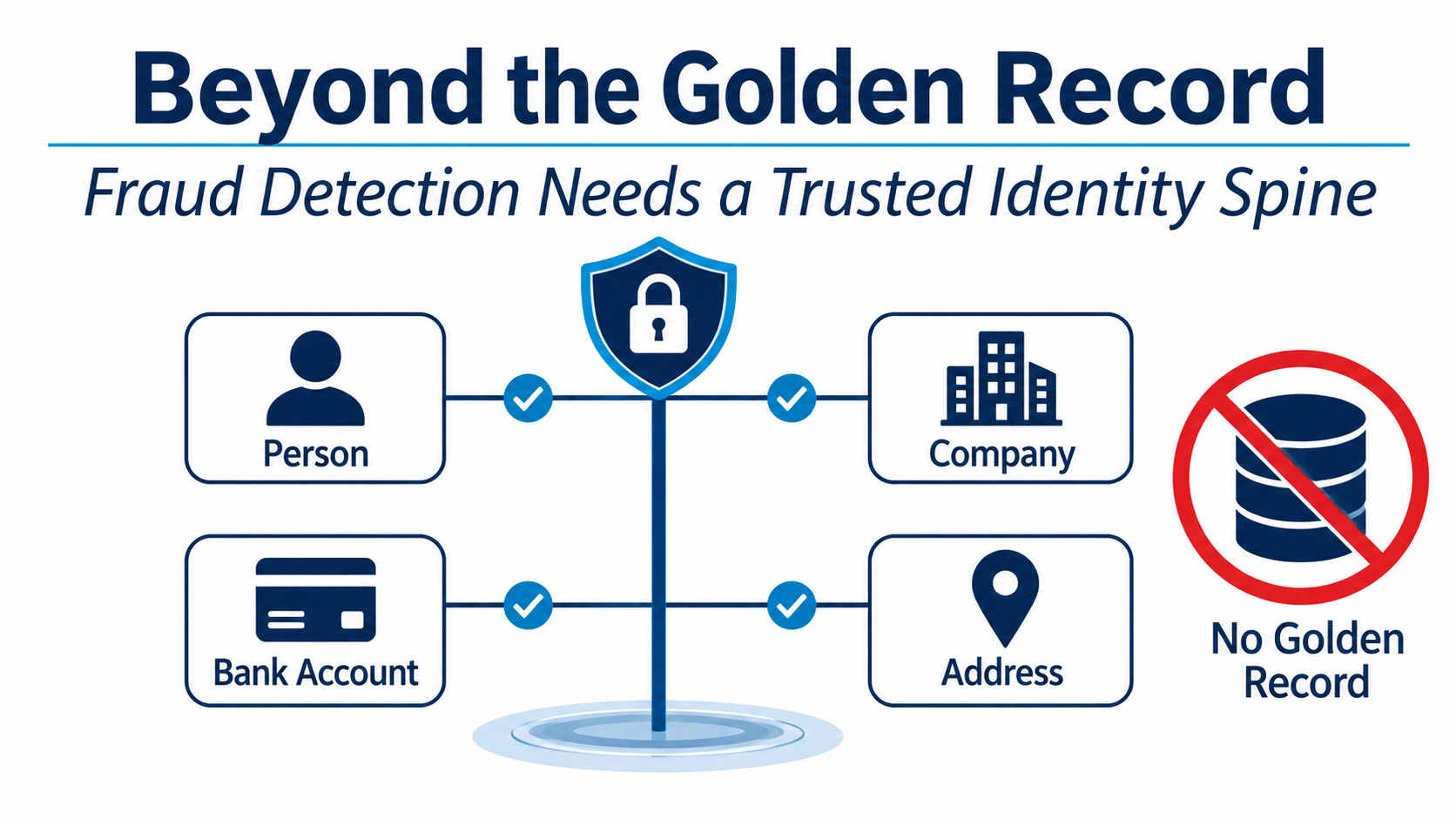
Why fraud detection needs a trusted identity spine, not a golden-record repository, and why resolving identities and managing relationships are different jobs.
Every fraud rule asks the same question: who is behind this transaction, and who else are they connected to? The more a fraud pattern depends on knowing whether parties are identical or related, the more its detection quality is bounded by the quality of identity and relationship data underneath it. Without reliable answers, even the best detection model has nothing to run on, so the work must start there. That is why fraud detection is one of the strongest business cases for master data.
Occupational fraud is neither a marginal nor an industry-specific risk. The Association of Certified Fraud Examiners’ 2026 global study draws on 2,402 investigated cases across 143 countries and territories and examines how fraud is committed, detected and controlled (Association of Certified Fraud Examiners, Occupational Fraud 2026: A Report to the Nations, ACFE, 2026).
Fraud detection does not merely need better golden records. It needs a trusted identity spine: distinct identities and the relationships between them, each with its evidence.
AI can find increasingly sophisticated patterns in transactions, but those patterns are only as meaningful as the identities and relationships underneath them. Master data management should therefore provide the trusted identity spine of fraud detection, while analytics interprets the graph built around it.
The problem: detection depends on identity
Transaction-centric and entity-centric fraud
Fraud detection can start from two different places, and the choice shapes everything that follows.
Transaction-centric fraud detection starts from the event and follows the chain event → behaviour → anomaly. A transaction happens, its behaviour is compared with what is normal, and an outlier is flagged. This works well for fraud that shows up in the transaction itself, such as an unusual amount, an odd time or a sudden burst of activity.
Entity-centric fraud detection starts from the parties and follows a longer chain: transaction → party → identity → relationship → pattern. Each transaction is first tied to the party behind it. That party is resolved to a single identity, the identity is connected to the others it is related to, and the pattern is read from those connections. This is the only way to see fraud that looks ordinary in every single transaction and appears only in who is connected to whom: split invoices, made-up orders between related companies, one claimant under several identities.

This article is about the second kind. It is also where master data matters most, because every step after the transaction depends on it: party, identity and the persistent relationships between parties are all master data. The two approaches are not rivals. Transaction-centric models catch what the event reveals, and entity-centric detection catches what only the entities reveal.
Two processes, one dependency
Fraud analysis boils down to two processes, and people often confuse them. Discovery mines historical transactions and demographic data for outlier patterns. Analysts then investigate each outlier to decide whether it is harmless or fraudulent, and what it costs. The outcome is a fraud pattern. Detection takes those patterns and scans live sequences of events for matches, flagging a transaction when it finds one. AI is changing both: it can surface outlier patterns no analyst would think to look for, and it can score live events against them.
Both depend on knowing who and what is behind each transaction. A pattern that cannot tell whether two payments came from one person or two will never be found in discovery, and a rule that cannot tell will never fire in detection. This is a master data problem before it is an analytics problem.
Most fraud programmes I see start with the tooling and discover the identity problem along the way. I suggest reversing the order.
Fraud tactics change. Identity foundations endure.
Fraud analytics has a structural weakness: the people on the other side read your controls and adapt, so every detection rule has a shelf life.
The purchase approval threshold is the textbook case. Invoices above DKK 100,000 need an extra sign-off. A rule that flags any invoice of DKK 100,000 or more takes an afternoon to build, and it is just as easy to evade: split a DKK 110,000 invoice into two of DKK 55,000.
Procurement teams saw this coming. Their controls now look for several invoices from the same supplier within a defined period and treat them as one large purchase. That control assumes the organisation can say with confidence that both invoices come from the same supplier. Without reliable identity resolution, the rule has nothing to stand on.
Fraudsters will route around any threshold. The identity layer is what lets the next rule, and the one after that, work at all.
Identities themselves do change. Companies are renamed, merged and sold, and people move and change names. What endures is the persistent identifier and the history attached to it, so that today’s record still connects to last year’s.
Real schemes are rarely as simple as one supplier sending two invoices. They involve many transactions by several people acting together, each of whom looks unremarkable alone.
Take a commercial finance provider that finances production orders. A company (the emitter) holds an order from a customer (the remitter), and the provider advances cash so the company can make the goods. The risk is a scam built on made-up orders: the company and the customer who supposedly placed the order are the same party, or controlled by the same people, and the money is paid out against goods nobody will ever buy.

The control is simple to state. The remitter and the emitter must not be the same party. It is much harder to run. The two can appear under different names, addresses or company numbers, or be tied together through shared owners, directors or bank accounts. Catching that takes resolved identities for clients and their customers, and the links between them, held as data before the first order is financed. FATF’s guidance on beneficial ownership makes the same point at national level: authorities need adequate, accurate and up-to-date information about who ultimately owns or controls a legal person, and should combine several sources instead of treating one register or company declaration as definitive (Financial Action Task Force, Guidance on Beneficial Ownership of Legal Persons, FATF, 2023).
The idea: a trusted identity spine
Why a golden record is not enough
Most master data thinking still follows one chain: duplicates → match → merge → golden record. It is a good chain for a customer list. For fraud it is not enough, and in places it does harm.
Identity resolution and relationship management solve different problems. The first decides whether two records describe the same real-world party. The second describes how two parties that remain distinct are connected. A fraud investigation may need both answers, but they must not be confused. Two companies sharing a bank account may be suspicious precisely because they are two different companies, not because they should be merged into one.
What fraud detection needs is a different chain: resolve identity → preserve distinct entities → model relationships → interpret relationships in context. The first step is familiar. The next three are where most programmes stop short. Distinct entities stay distinct even when they share an attribute. Relationships are recorded as data in their own right. And a relationship is read against the control it bears on, because the same link means different things in different settings.

This distinction is the centre of the article. Call what it produces the trusted identity spine: persistent identities that stay distinct, the relationships between them, and the evidence behind each. The argument holds with or without AI.
Master data makes the relationships visible
The first argument for master data in fraud work is usually record linkage: showing that two transactions attributed to different people belong to one. That has value, but skilled fraudsters know it, and the careful ones will not leave that trail.
The larger contribution lies in the relationships between entities. Picture the wall in a crime drama where investigators connect photos of people, places and events with string. Every item is a uniquely identifiable thing, and the investigation happens in the connections. A well-run multi-domain master data programme builds that wall as a standing asset. It resolves records to unique identities, gives each a stable identifier and, most importantly, records the relationships between customers, suppliers, locations, accounts and the other domains involved.
Concrete examples help. An identity link says that two records, such as two supplier records, describe the same company. That belongs to identity resolution and ends in a merge. Everything else is a relationship between distinct parties. A business relationship says that one company owns or controls another. A transactional relationship arises from activity, for example several claims paid into the same account. These describe what kind of relationship it is, not how far it can be trusted.
Not every relationship is master data in the strict sense. A payment from a claimant to an account is a transactional fact and stays in the transaction systems. Ownership, by contrast, is a persistent relationship that can be maintained as master data. The foundation does not need to hold every transaction or every investigative link. It needs trusted identities and persistent relationships that make transactions and investigations meaningful.
With that in place, analysts can follow transitive links: A shares an address with B, B shares a bank account with C, and C is a supplier invoicing the same approver as A. No single record shows this. The pattern appears only when the relationships exist as data. How much weight each link deserves is the subject of the next section.

A single domain can expose simple patterns, such as split invoices from one supplier. The more telling patterns usually cross domains, so party, account, location and transaction data must be connected to each other, not just clean in their own silos. That ability to connect them is what widens the range of patterns detection can find.
Which relationships matter
Not every relationship is suspicious, and not every shared attribute establishes one. Two companies may share an address because they use the same accountancy firm. Two people may share a bank account because they are married. A programme that stored every overlap as a relationship would bury the ones that matter. It helps to separate three things.
A confirmed relationship is established by evidence and can be stated as fact. A company register shows that one person owns both companies, or a contract names one party as guarantor of another. It is recorded with its type, its source, the date it was established and the period for which it holds, because ownership and control change.
A potential connection is a shared attribute that suggests a link but does not prove one: the same address, telephone number, bank account or contact person. It is worth recording as a candidate, together with the attribute that produced it, but it is not yet a confirmed relationship. It stays a candidate until evidence or a steward’s review confirms or rejects it.
A fraud indicator is different in kind. It is not a fact about two parties but a reading of their relationship against a particular control or pattern. A confirmed ownership link between a remitter and an emitter is an indicator only because the financing rule requires the two to be independent. The same link between a parent company and its subsidiary is entirely ordinary in another setting.
A fraud-relevant relationship is therefore one that bears on a specific control. Deciding which relationship types matter for which pattern, and how much evidence each needs before it counts, is part of the design. It is how a programme can record many connections and still produce few, meaningful alerts.
Put together, these are not three labels but a ladder. Each rung is a different state of knowledge about the same pair of parties, and each step up needs something specific to happen: observed attribute → potential connection → confirmed relationship → fraud indicator → decision. Between the rungs sit evidence or review, then the application of a control, then investigation. The table sets it out.
| State | What we know | What moves it up | What is recorded |
| Observed attribute | Two records hold the same value, such as an address or an account number. | Matching the value across records. | The attribute, the records and the source. |
| Potential connection | The shared value suggests a link, but nothing confirms it. | Evidence or review: a register, a contract or a steward’s decision. | The attribute behind it, its confidence and its limitations. |
| Confirmed relationship | The link is established as a fact about two parties. | Applying a control: reading the relationship against a specific rule or pattern. | Type, source, date established and the period it holds. |
| Fraud indicator | The relationship matters for a particular control. | Investigation by people. | The control, the relationship and why it matters. |
| Decision | A person has decided whether it is fraud and what to do. | Nothing further. This is the end of the ladder. | The decision, who took it and the evidence it rested on. |
Two rules follow from the ladder. A link moves up only through evidence or review, never because a model or a rule would like it to. And every rung keeps its source, its confidence and its limitations, so that anyone relying on it can see where it stands and why. This is the same idea as treating a golden record as a belief supported by evidence, not a mirror of reality (see Golden Records Are Beliefs, Not Mirrors, in Related reading). A master record states what we currently believe, how strongly and on what grounds.
A relationship is not a fraud finding. It is evidence that changes the context in which a transaction should be evaluated. The same shared address may be entirely legitimate for one type of relationship and highly unusual for another. The detection logic must therefore understand both the relationship and the business process in which it occurs. This also widens the picture of false positives. Inaccurate identity resolution creates noise, but so does misreading a legitimate relationship.
A fraud-capable relationship model
The ladder is a set of principles. It also turns into a data model, and the model is small. It has four parts.
- Entity. A persistent ID and its attributes. This is what stays distinct: two companies that share a bank account keep two IDs.
- Relationship. A subject, a predicate and an object, for example Company A owns Company B, with a valid-from and a valid-to date. It is a record in its own right, typed, directional and bounded in time, not a column on either party.
- Evidence. The source, the extraction method, the observation date, the confidence and the reviewer. One relationship can rest on several pieces of evidence, and they can disagree.
- Assertion state. Proposed, confirmed, rejected or superseded. This is where a relationship stands on the ladder at any moment.
Evidence is kept apart from the relationship it supports, and both are kept apart from the entities. The ladder maps onto this directly. Observed attributes and potential connections are proposed assertions, and a confirmed relationship is a confirmed one. Fraud indicators are not stored in the master data at all. They are what a control produces when it reads confirmed relationships, and decisions belong in case management.
Three things follow. First, nothing is merged that should not be, because a shared attribute can only ever produce a proposed relationship, never a merge.
Second, time becomes explicit. The valid dates say when a relationship held, and the observation date says when the organisation learnt of it. Together they let an investigator ask who owned the supplier on the invoice date, and what was believed at the time. Ownership changes, and a case judged on today’s ownership can be wrong.
Third, rejection becomes information. A rejected assertion stays on record with its reviewer, so the same weak link is not proposed again and raised as an alert again. That is a direct route to fewer false positives.
This is no longer generic master data advice. It is a fraud-capable relationship model: entities that stay distinct, relationships that are records in their own right, evidence that travels with every claim, and a state that says how far each claim can be trusted.
The spine and the graph around it
Two words have been doing the work in this article, so it is worth being exact about them. The spine is what master data owns. The graph is what analytics builds.
The spine is small and slow-moving. It holds the persistent identities, the relationships between them with their state, and the evidence behind each. It is governed: someone owns it, changes to it leave a trail, and nothing enters it without a source.
The graph is large and fast-moving. It starts from the spine and adds what analytics needs: transactions as edges, derived features, inferred links, model scores. It can be rebuilt or thrown away for a new question. What it must not do is quietly change the spine. When analytics finds a link worth keeping, the link goes back as a proposed assertion with its evidence and climbs the same ladder as any other.

That division settles a few things. The golden record stops being the product and becomes one view of the spine: the best-supported belief about a party at a given moment, with the evidence still attached. Accountability for a wrong link has a clear owner, because every link carries its source, its method and its reviewer. And a model can be replaced without touching the identities it was reading.
It is also why ‘repository’ is the wrong word. A repository stores records. A spine carries beliefs, together with the evidence for them, to whatever needs to read them.
Putting the spine to work
A worked example: what master data lets a benefits agency see
A common benefits fraud scheme has people claiming under several identities, or for household members who do not exist, with the payments going to accounts the same few people control. Each claim ties together three identifiable things: a claimant, an address and a bank account. Separate claimants and separate claims may point to the same payment destination.
Processed one at a time, every claim looks routine and gets paid. Master data changes that. Once identities are resolved and relationships documented, the agency can ask questions the claims system alone cannot answer:
- Are claims under different names being paid into the same bank account?
- Is the same person claiming at the same time in different municipalities?
Both are patterns an agency would look for, and both become visible once claimants, addresses and accounts are mastered and connected. Without that foundation, the same checks rely on fuzzy matching across inconsistent source records, and the noise drowns the signal. Analysts learn to ignore the alerts, which is worse than having none. The UK’s National Fraud Initiative does this in practice, matching electronic data within and between public and private sector bodies to find discrepancies that no single system would reveal (UK Public Sector Fraud Authority, National Fraud Initiative, GOV.UK).
This matters most in public-sector benefits, where a false accusation can have serious consequences for an innocent claimant. A shared address may be a family home, and a shared bank account may belong to a carer or a guardian. The World Bank’s ID4D guidance treats identity proofing as a mix of validation, existence checks, claimant verification and deduplication, and warns that stronger proofing can raise costs and shut out legitimate people (World Bank Identification for Development, ID4D, Practitioner’s Guide: Proofing Identity Claims, World Bank). In public benefits, accuracy and proportionality have to go together.
| Fraud pattern | Master data requirement | Failure without it |
| Split invoices | One resolved supplier identity across vendor records | Each invoice appears to come from a different supplier |
| Same claimant paid in several municipalities | Stable claimant identity and resolved payment history | The same person appears as unrelated claimants |
| Several claimants paid into one bank account | Resolved claimant and account identities, with the payment relationship | Account details remain isolated in separate systems |
| Related parties in financing | Resolved identities and documented ownership and control relationships | The remitter and emitter appear unrelated |
What AI and analytics models need from master data
Analytics tools and machine learning models pay off only when the entities underneath them can be trusted, and that trust comes from the established disciplines of master data management. Each adds something to the question that matters in order financing: are the remitter and the emitter really two different parties?
- Data quality and standardisation come first. Names, addresses and company numbers are cleaned, validated and put into a common format, so that the same company written in two different ways is recognisably one company.
- Entity resolution then matches and merges records that describe the same real-world party, across systems and spellings. This is the step that reveals that the remitter on one order and the emitter on another may be one and the same. Survivorship rules decide which values to trust, and a persistent identifier gives the resolved party a single key that outlasts system changes.
- Relationship and hierarchy management goes beyond the party itself. It records who owns whom, who directs whom, and which bank accounts, addresses and contact persons are shared. This is where the remitter and the emitter stop being two names and become two nodes with a path between them, such as a shared owner behind a holding company. A check that only asks whether the two are different records will pass that order. A check that follows the relationships will not.
- Reference data supplies the outside view: company registers, ownership registers, country and industry codes. Without it, internal records can only be compared with each other. With it, declared information can be checked against external ownership and control information. Registers can be incomplete or out of date, so the source and its limitations are recorded with whatever is used.
- Governance and stewardship keep all this trustworthy over time. Someone owns the match rules and the relationship data, reviews the doubtful matches that automation cannot settle, and records why a link was accepted or rejected. That trail matters when a case reaches an investigator or an auditor.
Together, the disciplines turn a single control, that the remitter is not the emitter, from a name comparison into an answer that holds up under scrutiny: not the same party, not owned by the same people and not paid into the same account.
Capturing this is only half the work. If analysts cannot search, retrieve and browse the data without waiting for a data engineer, the investment sits unused. Getting master data to the people and systems that investigate fraud is a challenge of its own, which I will cover in a separate post.
How identities are resolved, and where matching goes wrong
Entity resolution is easy to name and hard to do well. UK government identity guidance notes that a single attribute is usually not enough to tell one person from another. Confidence comes from combining attributes, validating evidence, checking that an identity has existed over time and confirming that it belongs to the person claiming it (UK Government Digital Service, How to Prove and Verify Someone’s Identity, GOV.UK, updated 2024). That is identity proofing, a related but different discipline: entity resolution asks whether records probably describe the same party, while identity proofing asks how confident we can be in a claimed real-world identity. There are two broad ways to decide that two records describe the same party.
Rule-based matching applies explicit conditions, such as the same company number, or the same name and postcode. It is transparent and easy to explain, but it only finds what the rules anticipate, and it struggles when data is incomplete, misspelt or deliberately varied. Probabilistic matching instead scores how likely two records are to be the same, weighing evidence such as name similarity, shared addresses and shared bank accounts. It catches variants that rules miss, at the cost of being harder to explain and tune. A probabilistic match is not automatically a confirmed identity. The score and the evidence behind it should be kept, and it should be defined in advance which matches can be resolved automatically and which need review. Most programmes end up combining the two: firm rules for the clear cases and scoring for the grey area. Machine learning and language models extend the scoring side, which makes the review rules more important, not less.
Every approach rests on a match threshold, and the threshold is a trade. Set it too strict and real links are missed, so the remitter and the emitter stay two unrelated names. Set it too loose and unrelated parties are merged. Over-merging does its own harm: honest customers are flagged as fraudsters, genuine relationships are hidden inside oversized records, and analysts lose trust in the alerts. For fraud work, the right setting depends on the cost of each kind of error, so it is a business decision as well as a technical one. NIST takes the same view of identity assurance. Its current guidelines treat it as risk management, not a pass-or-fail data check, distinguish impersonation, synthetic identity fraud, forged evidence and social engineering, and call for controls in proportion to the impact of an identity failure (National Institute of Standards and Technology, SP 800-63-4 Digital Identity Guidelines, NIST, 2025).
Every match must also be explainable. An investigator needs to say why two records were treated as one party, which attributes matched and how strongly, and who confirmed the match if a person reviewed it. A link may still be useful evidence when its explanation is incomplete, but its provenance, confidence and limitations must be visible before anyone relies on it for a decision. They are also what make it possible to correct the link when it turns out to be wrong. That is why match logic is documented, versioned and owned, and why uncertain matches go to a data steward instead of being merged silently.
Where AI fits
What machine learning adds to detection
Machine learning is the part of AI that most directly improves how fraud is found. It can catch more fraud, earlier, with fewer false alarms than fixed rules alone, because it learns from the data and keeps adapting as tactics change. The gains are real, but they depend on what the models learn from.
Three approaches matter in practice. Supervised models learn from cases already labelled as fraud or not fraud, and apply that to new transactions that look similar. Unsupervised models need no labels. They hunt for anomalies, so they can surface risks nobody thought to look for, which matters because tactics keep shifting. Used together in an ensemble, they cover both known and emerging threats and strike a better balance between catching fraud and flagging innocent activity.
Machine learning also saves effort, not just improves accuracy. It can suggest new detection rules and keep existing ones up to date from historical data. It can test which mix of techniques works best on your own data, with newer methods such as gradient boosting complementing established ones such as neural networks. And it can take over parts of the investigation, such as pulling together related records and ranking alerts so that analysts start with the likeliest cases.
Because tactics keep changing, the models have to keep adapting while staying transparent and accountable. The people relying on them need to see why a case was flagged.
Every one of these gains runs through the entity layer. A supervised model learns from labelled cases, and a case labelled against the wrong identity teaches the wrong lesson. An unsupervised model looks for anomalies, and unresolved identities create false ones: a supplier split across five records looks like five unremarkable suppliers, while two unrelated parties merged into one look like a spike. Alert ranking and automated investigation only work if everything known about a party and its relationships can be pulled together. Master data is what turns machine learning from a smarter rule engine into something that can see who is behind the transactions.
What AI changes
AI does change things here, just not in the way tool vendors tend to claim. It does not replace the identity layer. It makes that layer matter more, and it makes it cheaper to build. Either way, organisations with trusted identities and documented relationships will get more out of AI than those without.
First, fraudsters have AI too. Generated documents, synthetic identities and convincing fake invoices make any single record less trustworthy, and they make it cheap to create plenty of plausible parties. Europol has identified deepfakes as an enabler of document fraud, impersonation and CEO fraud, which is why a convincing document, voice or video can no longer count as proof of identity on its own (Europol Innovation Lab, Facing Reality? Law Enforcement and the Challenge of Deepfakes, Europol, 2022, updated 2024). A control that leans on one document or one attribute is easy to beat. A web of identities, relationships and history that holds together across independent sources is far harder to fake, and that web is what the spine holds.
Second, AI speeds up the master data work itself. Language models can read contracts, annual reports and registry extracts and suggest the ownership links that today sit in documents and in people’s heads. Machine-learned matching can resolve records that rules cannot, and AI can sort the doubtful matches so that stewards spend their time on the hard ones. The cost of building the relationship layer, which has long been the main obstacle, comes down.
This is where the boundary between evidence and decision earns its keep. What AI produces is evidence with a level of confidence, not a fact. INTERPOL’s work on synthetic media covers generated text and synthetic IDs as well as manipulated images and audio, which is one more reason to keep the origin, method and confidence of machine-produced evidence, instead of letting it become a master data fact automatically (INTERPOL, Beyond Illusions: Unmasking the Threat of Synthetic Media for Law Enforcement, INTERPOL, 2022). A link pulled from a document, a probabilistic match and a model score all enter the ladder as potential connections, with their source and confidence attached, and move up only through evidence or review. If an AI writes its suggestions straight into the master record, a guess becomes a fact with no trail. If it proposes and a governed process confirms, you get the speed without losing the explanation.
So the AI argument comes down to the spine. AI moves the bottleneck in fraud detection from analytics to trusted data, and it moves the risk from missing a pattern to acting on one you cannot explain. A trusted identity spine deals with both. It gives AI identities and relationships it can read, and it gives people the provenance and governance to trust what it finds. Organisations that treat AI as a reason to skip the spine will find fraud faster and be worse at explaining it, to investigators, to auditors and, in the public sector, to the citizen who was wrongly flagged.
AI and master data inform the decision, they do not make it
None of this makes master data, or AI, the fraud decision. Master data’s job is to establish who the parties are and how they are connected, and to say how sure it is. Whether a connection is suspicious, whether a payment is held and whether a case is opened are judged by detection rules and models, and decided by people.
Keeping the two apart guards against a misreading of this article: that the answer is to merge every connected entity. Merging them removes the very relationship an investigator needs to see, and it makes honest customers who share an address or an adviser look like a single suspect.

The separation also gives each of the article’s concerns a clear home. False positives fall when detection treats confirmed relationships differently from potential connections, instead of reading every shared attribute alike. Explainability improves because each link carries its type, its evidence and its status, so an investigator can see what the data established and what a rule or a person concluded. Governance becomes sharper because the owners differ: stewards own the match rules and the relationship data, and the fraud function owns the rules and thresholds that act on them. What happens next is a fraud decision, and it should be taken and recorded as one.
Getting started
Measuring the value
Master data rarely gets funded because it is good practice. It gets funded because someone can show what it is worth, and fraud is one of the few areas where the value can be counted. Three measures work well, and each can be baselined before the first matching rule is built.
- Cases where identity or relationship evidence mattered. Losses prevented are hard to prove, because the counterfactual is unknown. Track instead the cases, and their value, where identity or relationship evidence materially contributed to a decision, for example financing refused because the remitter and the emitter proved to be the same party. Distinguish confirmed fraud prevented, suspected fraud blocked pending investigation and recoveries, so that each figure can be traced to the evidence behind it and is not credited to master data alone.
- Fewer false alerts. Resolved identities remove duplicate and mistaken matches, so fewer alerts are raised against parties that turn out to be harmless. Track the percentage of alerts that lead to a confirmed case. If it rises, better identities and relationships are likely helping.
- Less investigation time. Analysts spend much of each case collecting and reconciling data about who is involved. Measure the median time from alert to decision before and after. Relationships held as data shorten that work, because the connections are already there.
Set the baseline before the work starts, and report the three measures together. Fewer alerts alone may mean missed cases, and more blocked transactions alone may mean over-flagging. Taken together, they show whether better master data makes detection both more accurate and cheaper to run.
Kick-starting master data as a fraud detection foundation
- Pick one fraud pattern you already know costs money, such as split invoices or a remitter and emitter who are the same party, and use it as the business case for your first master data scope.
- Write down which entities and relationships the pattern needs in order to be visible. These become the domains and relationship types in scope, and give you a short, defensible list.
- Assess each entity: does it have a stable identifier today, do two systems agree on it, and is the data good enough to match on?
- Find out where the relationships live. If the answer is ‘in someone’s head’, capturing them as data, with their evidence and assertion state, is your first piece of master data work.
- Appoint owners and stewards for the match rules and the relationship data. An unowned match rule drifts, and the drift stays invisible until a case goes wrong.
- Only then connect the detection logic, including any AI models, to the mastered data, and let each new pattern reuse the same identity layer.
In short
Detection rules will keep changing as fraudsters change tactics. Master data is what lasts: the resolved identities and documented relationships that every rule runs on and every new pattern can reuse. It is a trusted identity spine, not a golden-record repository. A known business risk decides which identities and relationships must be established first, and those then serve every later control. The spine is also hard to bolt on once the models are live.
Questions to test how well your master data supports fraud detection:
- Can our master data say with confidence that two transactions belong to the same person, company or account, and that a remitter and an emitter are not the same party?
- Which fraud patterns would we need a relationship between entities to see, and do we hold that relationship as mastered data?
- Who owns the match logic, and when was it last reviewed?
- Which domains would have to be connected for our most expensive pattern to show up?
- Can an analyst browse this without asking someone else to pull it?
- Do we record whether a link is confirmed or only a potential connection, and who decides which links count as fraud indicators?
- Could we explain, with source and confidence, every link that an AI model relies on or proposes?
Leave a Reply