Table of contents
- 1. Business intents and SAP capabilities
- 2. When rules collide and products are phased out
- 3. Data quality, governance and practical checks
This article is divided into three pages. Use the page navigation at the bottom to continue.
Where substitution, supersession and phase-out rules live in SAP, how they collide, and what it takes to govern product lifecycle changes
A customer orders product 4711-A. The order confirmation says 4711-C. Nobody in sales operations remembers approving that. The planner points to a follow-up material in the material master that says 4711-B, and the logistics team is surprised that either product was shipped from that plant.
This scenario is constructed, but each part reflects problems that can arise when several SAP capabilities influence the same order. SAP provides different ways to represent product replacement, availability alternatives and lifecycle changes. Some are genuinely separate mechanisms; others overlap or are different uses of the same underlying functionality. They are maintained in different places and often by different teams. Taken together, they can form one business rule set with no single owner. The same question arises whenever a product is replaced by a newer version or phased out, so the subject is the whole lifecycle change and not only the swap on an order.
This post maps those mechanisms, shows where they collide, follows a product phase-out through a production company, lists the data quality problems that result, and proposes a governance model that fits into a normal product data operation. It assumes SAP S/4HANA and standard functionality. Field names, configuration paths and behaviour vary between releases, so test the details in your own system before relying on them.
What a substitution or supersession rule actually says
A substitution rule states that product B may be supplied in place of product A, under defined conditions. The conditions carry the meaning. They can include a validity period, a plant, a sales organisation, a customer or customer group, a stock situation, or a lifecycle status. A rule without conditions rarely matches what the business intends. A supersession rule is the lifecycle version of the same statement: B replaces A permanently from a given date. This post uses “rule” for both, and for the phase-out settings that go with them.
Three questions describe any rule: when does it fire, what does it replace, and who decided it should. The first two are technical, and SAP answers them differently depending on the mechanism. The third is a business question, and it is the one most often left unanswered.
A substitution rule is a business decision stored as data. It commits the company to shipping something the customer did not name, and it changes price, delivery, compliance status and sometimes the customer’s contractual position. That puts it closer to a pricing agreement than to a descriptive attribute such as a material description. A supersession or phase-out decision works the same way, because it determines what is bought, produced and written off for months afterwards.
Why this is a master data problem
Product master data programmes usually define scope by object: the material master, its classification, its units, its plant and sales views. Condition records and ATP configuration, both described below, sit outside that scope because they are classified as pricing or logistics data. Substitution, supersession and phase-out rules fall into exactly that gap. The material master may be well governed while the rules that decide which product reaches the customer are maintained by three other teams, with no shared register and no shared definition of quality.
Two consequences follow. Data quality metrics on the material master report healthy numbers while customer-facing substitution behaviour degrades. And when a customer complains, nobody can produce a list of every rule that could have caused the swap.
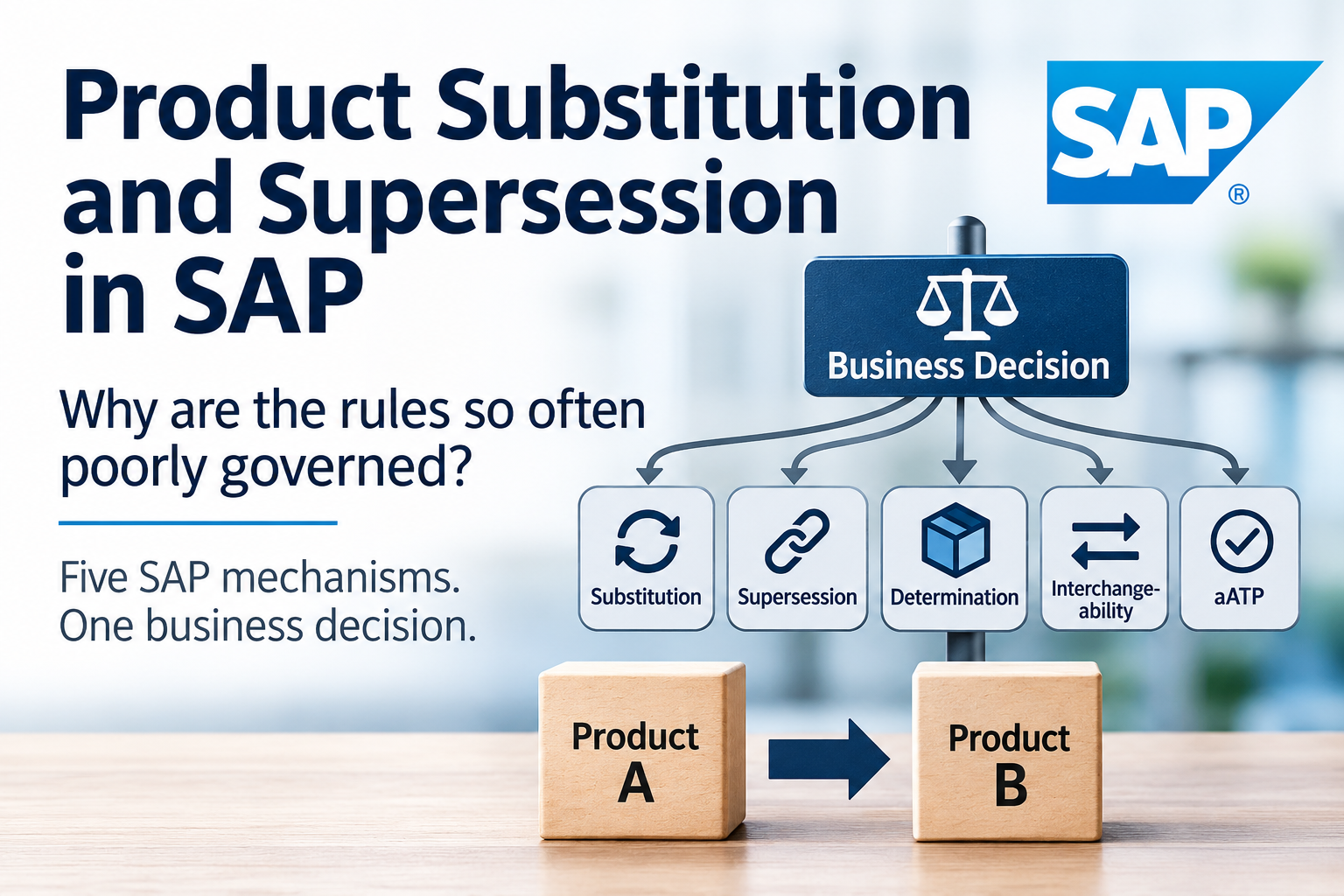
One business decision, several technical representations
Imagine engineering decides that material A is to be replaced by material B. That is one business decision. It may need to be reflected in the material master, bills of material, purchasing, sales substitution, availability checking, product interchangeability, inventory planning and financial forecasts. These are not eight independent decisions. They are the operational consequences of one decision.
The problem is not that SAP has several mechanisms. The problem is that the business decision is fragmented across mechanisms, processes and organisational responsibilities. Each team maintains its own technical representation of the decision, while nobody necessarily owns the decision itself. A central register is useful, but it is not the authority. The authority is the agreed business decision, including its scope, direction, effective date and exceptions.
This is a question of governance scope, not a demand for another system. Product data governance needs to cover the relationships and rules that influence how products are selected, supplied and retired, not only the attributes stored on the material master.
Four business intents, several SAP mechanisms
It is tempting to start with a list of SAP transactions and configuration objects. I find it more useful to start with the business decision. Most product replacement scenarios fall into four different intents, and confusing them is one reason why organisations end up with overlapping rules.
1. Lifecycle replacement
A product is being replaced by a successor. The change is normally permanent, has an effective date and may involve a controlled run-down of existing stock. Material master discontinuation and follow-up data can support this in planning. Supersession chains can represent the relationship between product generations where Product Interchangeability is available and used by the relevant application.
2. Commercial replacement
The company deliberately maps one product to another for a commercial reason. Examples include a customer-specific product number, a packaging change, a promotion or a planned sales changeover. The original product may still be perfectly valid and available. Sales product substitution and material determination can support these scenarios, but they are technical implementation choices, not two automatically distinct business decisions.
3. Availability-driven alternatives
The requested product remains the customer’s request, but the company cannot confirm the required quantity or date. The system may propose an alternative product, plant or storage location, subject to the configured strategy and constraints. This is an availability decision, not necessarily a permanent product replacement.
4. Product equivalence
Two or more products are equivalent for a defined use, without one necessarily being the successor of another. A second source or supplier variant is a typical example. Product Interchangeability can represent this through Form-Fit-Function (FFF) classes. Equivalence must still be bounded by the application, plant, specification and business context in which it is valid.
These intents can lead to different SAP mechanisms, and a single product may appear in more than one scenario. The important point is to record the business decision once, then implement it consistently in the mechanisms required by the affected processes.
How SAP implements these decisions
The following are the main standard capabilities encountered in an S/4HANA landscape. They overlap in places, and their exact behaviour depends on release, configuration and the consuming application.
Lifecycle replacement: material master data
Status fields and follow-up information sit on the material itself. The cross-plant material status (MARA-MSTAE), the plant-specific material status (MARC-MMSTA) and the distribution-chain-specific sales status (MVKE-VMSTA) can restrict how a material is used. The restrictions depend on the status configuration and the business function in question; a status is not, by itself, a complete phase-out process. For MRP discontinuation, the plant data includes a discontinuation indicator (MARC-KZAUS), an effective-out date (MARC-AUSDT) and a follow-up material (MARC-NFMAT). When the relevant settings and planning data are in place, MRP can use the old material up to the discontinuation point and transfer uncovered dependent requirements to the follow-up material.
This is a natural place to support plant-level lifecycle replacement and controlled run-down. It is not a universal replacement relationship for every process. In particular, BOM item-level discontinuation data can also be maintained, and a follow-up item specified in the BOM takes precedence over the follow-up material in the material master for that BOM item. The owner is normally product data management, engineering or supply chain. The weakness is granularity: a single follow-up material in the plant data cannot express customer-specific or time-limited sales alternatives.
Where SAP Product Engineering and Operations (PEO) is used, the engineering change process can also connect engineering packages and change notices with manufacturing BOM preparation, change record management and impact analysis. The diagram illustrates this PEO workflow, including the manufacturing change records and snapshot revisions that support the manufacturing view of the change. It is a process view of engineering change control, rather than another product-substitution mechanism.

Figure 4. PEO engineering change and manufacturing workflow.
Commercial replacement: SD material determination and product substitution
In classic Sales and Distribution, material determination is the condition-technique capability commonly used for product substitution. It resolves a material entered on a sales document to a target material. The condition records identify the source and substitute materials, while the material determination type and substitution reason control the scenario and how the system responds. The same capability can support several business uses: translating a customer material number, replacing a discontinued product, changing to promotional packaging, or selecting an alternative when the requested product is unavailable.
The important distinction is not between two supposedly independent SAP mechanisms called product substitution and material determination. It is between the business intent and the way the condition record is configured to fulfil it. Some material determination scenarios replace the entered material without an inventory check; others use ATP-related product selection. The trigger and result therefore depend on the determination type, substitution reason and configuration. Do not assume that every record replaces the material regardless of stock.
For classic SD material determination, SAP retains the originally entered material in the sales document item (VBAP-MATWA), which can support reporting on the requested material as well as the determined material. The owner is usually sales operations or order management, but the approved product relationship and its commercial implications need a business owner. These condition records are often outside the scope of a material master programme, even though they can change what the customer receives.
Availability-driven alternatives: ATP and aATP
In S/4HANA, advanced available-to-promise (aATP) includes Alternative-Based Confirmation (ABC). When the requested product cannot be confirmed as requested, ABC can calculate and propose alternatives according to a substitution strategy. Depending on the strategy and configuration, alternatives can include another product, plant or storage location. The original request is not simply rewritten by a standing product-pair record: the system evaluates what can be confirmed and which alternatives are permitted. Hard constraints and the configured search strategy matter, so ABC should not be described as an unrestricted substitute lookup.
This is fundamentally different from a permanent supersession. A product may be offered as an alternative because of today’s supply situation and still remain a valid product in its own right. The business must decide whether the customer can accept that alternative and whether the proposal is automatic or requires confirmation.
Lifecycle and equivalence: Product Interchangeability
Product Interchangeability is SAP’s framework for maintaining product relationships used by planning and order-fulfilment applications. Be precise about the release statement: the Manage Product Interchangeability Fiori app is introduced for SAP S/4HANA and SAP S/4HANA Cloud Private Edition with 2025 FPS02. That is not the same as saying that every form of product interchangeability first became available in that release; related functionality existed in earlier SAP SCM and planning contexts. Interchangeability is the broader framework. Supersession is the lifecycle case in which a successor takes over from an earlier product. Substitution is the operational outcome that different SAP capabilities can produce.
The framework stores relationships in collections of two broad types. A supersession chain is a sequence of products that can replace one another as a product moves through generations. It represents lifecycle replacement. A Form-Fit-Function (FFF) class groups products that are identical in their technically relevant form, fit and function; it represents equivalence, not a predecessor-successor relationship. FFF classes do not have validity dates. Their product membership is not itself location-specific, so planning scenarios use location-specific subsets and a leading product where required. This distinction matters: a class is a technical equivalence statement, not a blanket commercial approval for every customer or process.
Within a supersession chain, relationships can use different substitution types: 1:1 (one successor replaces one predecessor), 1:n OR (one predecessor has several alternative successors), 1:n AND (several successors together replace one product, relevant only to certain applications and forward only), n:1 OR (several predecessors can be replaced by one successor) and 1:0 (a product is discontinued without a successor). Each relationship also has a direction. Forward means the old product can be replaced by the new one but not the reverse. Full means the products can replace each other. Do not read the word full as a general statement that two products are interchangeable in every commercial or operational context; the consuming process still matters.
Two controls shape how a chain is read. An exit indicator stops the system from following a chain beyond a defined point. A product exclusion removes a specific product from the result, for example because of a quality issue in current stock, while the system keeps evaluating the rest of the chain. Collections and individual relationships can be created, activated, deactivated and made obsolete. Where the relevant integration is active, aATP Alternative-Based Confirmation can use supersession information as an input to its alternative search. That does not make the interchangeability framework and ABC the same thing: one maintains product relationships, while the other evaluates what can be confirmed under a configured strategy.
The owner is typically supply planning or product data management. Its strength is that the structure, lifecycle and relationship logic are explicit. Its risk is that it becomes another place to maintain a decision already represented elsewhere. Use it where it is the appropriate source for the consuming process, and govern the links to other mechanisms rather than assuming it replaces every existing substitution capability.
Do not assume that every consuming SAP application supports every relationship type in the same way. Product interchangeability capabilities depend on the release, configuration and application. For example, PP/DS has specific restrictions on supersession-chain structures, including linear-chain behaviour. A relationship that can be maintained in one context should not automatically be assumed to work identically in another. Verify the behaviour in the application that will actually consume the relationship.
The table below lists the relationship elements used in Product Interchangeability. Their availability and interpretation must still be checked against the consuming SAP application and release.
| Element | What it means | Typical use |
| Supersession chain | A sequence of products that can replace one another over time | Product generations and part number changes, where a successor takes over from a predecessor |
| FFF class | Products with the same form, fit and function, treated as equivalent | Equivalent alternatives such as second-source or supplier variants, where no product is the successor of another |
| 1:1 substitution | One successor replaces one predecessor | Straight replacement of an old product by a new one |
| 1:n OR substitution | A predecessor can be replaced by any one of several successors | Variants or alternatives that can each cover the demand, chosen by availability |
| 1:n AND substitution | Several successors together replace one predecessor; forward only, and relevant only to certain applications | Splitting an old product into a set of new products |
| n:1 OR substitution | Several predecessors can each be replaced by one successor | Consolidating variants into a single product |
| 1:0 substitution | A product is discontinued with no successor | Planned phase-out where remaining demand is simply run down |
| Forward direction | The old product can be replaced by the new one, but not the reverse | Cases where the newer product is not backward compatible |
| Full direction | The products can replace each other | Interchangeable versions with no functional difference for the customer |
| Exit indicator | Stops the system following a chain beyond a defined point | Limiting how far back or forward a substitute may come from |
| Product exclusion | Removes a specific product from the result while the rest of the chain is still evaluated | Blocking a product temporarily, for example because of a quality issue in current stock |
The main SAP capabilities side by side
| Capability | Where the data is maintained | When it is used | Typical business owner |
| Material master and BOM discontinuation | Material master MRP data, BOM item discontinuation and follow-up data; material statuses | MRP planning, component run-down and configured status checks | Engineering, product data management, supply planning |
| SD material determination / product substitution | Material-determination types, substitution reasons and condition records | Sales-document processing; depending on the scenario, with or without an inventory check | Sales operations, order management |
| aATP Alternative-Based Confirmation (ABC) | Substitution strategies, alternative determination and related product or location data | When the original sales requirement cannot be confirmed as requested | Order fulfilment, supply planning |
| Product Interchangeability | Supersession chains and FFF classes, with relationship types, direction and relevant planning attributes | Supported planning applications and, where integrated, as an input to aATP alternative determination | Product data management, engineering, supply planning |
Leave a Reply