Category: Master Data Management
-
Why AI turns product data quality from a clean-up into a creation habit
One product record can get two verdicts on the same day. Purchasing reads description, base unit, supplier and lead time, finds all four filled and correct, and rates the record good. Costing reads description, standard cost and valuation class, finds standard cost empty and valuation class wrong, and rates the same record bad. Neither is…
-
Metacognition Applied to Master Data Management: Two Levels, Different Setting
I have a habit I’m slightly embarrassed by. Every so often, halfway through an argument, I stop and ask myself why I actually believe what I’m saying. More often than I’d like, the honest answer is “because everyone around me does”, or “because I read it somewhere once and it stuck”. It’s an unsettling question,…
-

Golden Records Are Beliefs, Not Mirrors
the real shift is from tracking whether our data is right to tracking whether we still know why. This blog post is a structured approach to epistemic governance in master data management, and why it matters more now that AI is doing the matching. It builds on the argument set out in Master Data as…
-
Master Data as Applied Epistemology
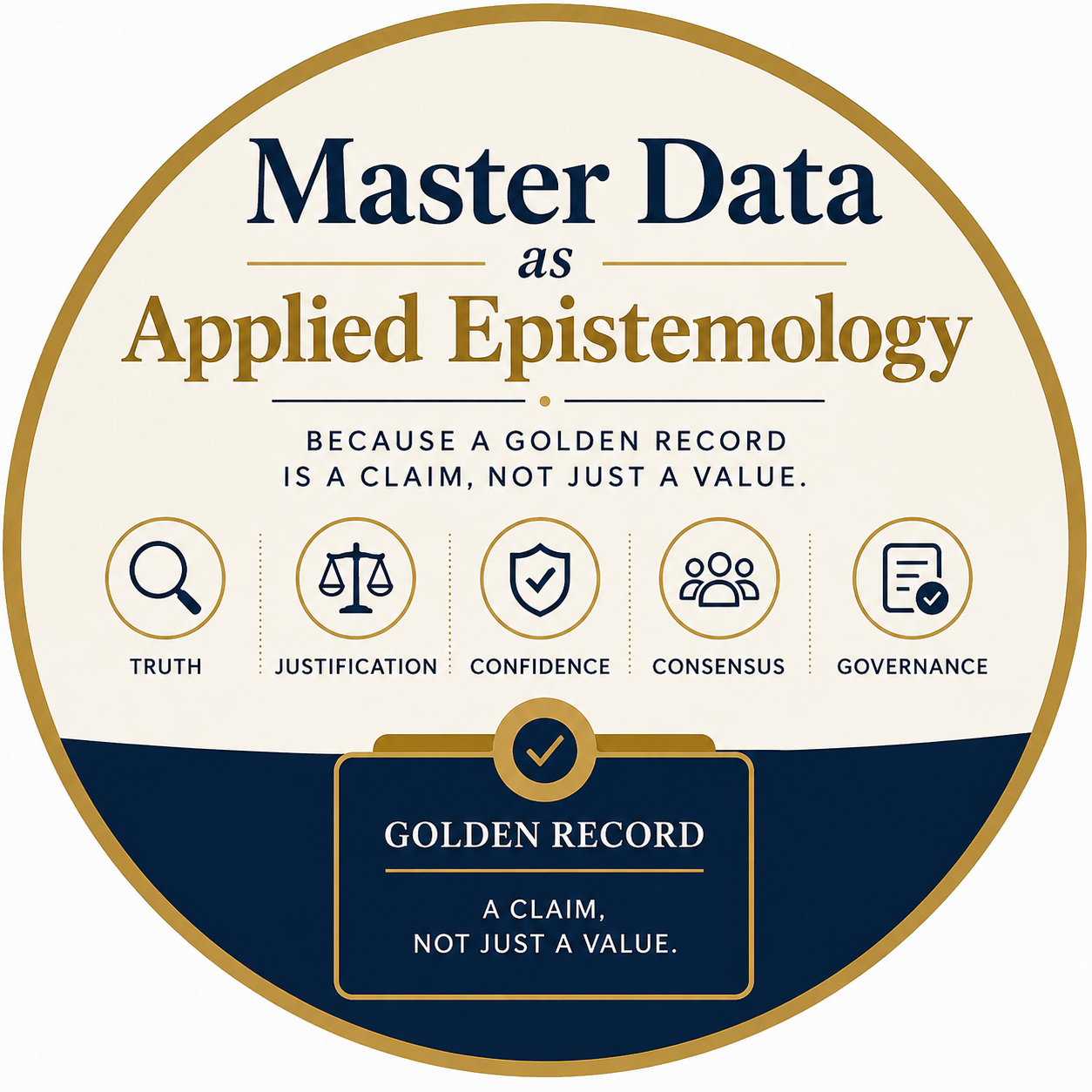
Two systems disagree about a customer’s address. A survivorship rule quietly picks one, and the workflow moves on. What happened there matters: understanding the quality of that decision requires understanding the philosophy behind it. This post runs dry, but that groundwork is necessary for building real understanding, architecture, and strategy. Why does that frame matter?…
-

MDM Implementation Styles: Analytical vs. Operational
We rarely see Master Data Management programmes pick a single, fixed architecture on day one. Instead, most fall along a spectrum: from lightweight styles that support reporting and analytics, to heavier styles that put MDM directly in the path of live business transactions. Once you understand where a given implementation style sits on that spectrum,…
-

The Importance of Measuring Data Quality from a Process Perspective
When we talk about data quality, we default to a snapshot mindset: pull a sample, run some checks, score the dataset, move on. It is a useful habit, but it treats data quality as a property of a table rather than as the outcome of everything that happened before that table existed. Quality that holds…
-

Governing AI-Assisted Software Engineering: Why “Vibe Coding” Needs Guardrails, Not a Ban
AI is no longer a nice-to-have in software engineering. It’s embedded everywhere, from inline code completion to autonomous agents that plan entire pieces of work and open their own pull requests. The most permissive end of this spectrum is what Andrej Karpathy called “vibe coding” — leaning fully into the suggestions an AI assistant gives…
-

Master Data at Birth: Why Golden Records Should Be Created, Not Reconciled
The case for making the MDM Application a synchronous or upstream step in data creation, rather than a downstream reconciliation layer, tends to rest on a few arguments. Prevent duplicate creation instead of cleaning it up after. If a new counterparty or asset record is checked against the MDM Application before creation, you catch duplicates…
-

The layer has a name: Ontology.
Traditional BI answers “𝗪𝗵𝗮𝘁 𝗵𝗮𝗽𝗽𝗲𝗻𝗲𝗱?” Semantic models answer “𝗛𝗼𝘄 𝘀𝗵𝗼𝘂𝗹𝗱 𝘁𝗵𝗲 𝗯𝘂𝘀𝗶𝗻𝗲𝘀𝘀 𝗺𝗲𝗮𝘀𝘂𝗿𝗲 𝗶𝘁?” Taxonomies answer “𝗪𝗵𝗮𝘁 𝗸𝗶𝗻𝗱 𝗼𝗳 𝘁𝗵𝗶𝗻𝗴 𝗶𝘀 𝘁𝗵𝗶𝘀?” Knowledge graphs answer “𝗪𝗵𝗮𝘁 𝗶𝘀 𝗮𝗰𝘁𝘂𝗮𝗹𝗹𝘆 𝗰𝗼𝗻𝗻𝗲𝗰𝘁𝗲𝗱, 𝗿𝗶𝗴𝗵𝘁 𝗻𝗼𝘄?” 𝗢𝗻𝘁𝗼𝗹𝗼𝗴𝗶𝗲𝘀 𝗮𝗻𝘀𝘄𝗲𝗿 “𝗛𝗼𝘄 𝗮𝗿𝗲 𝗮𝗹𝗹 𝗯𝘂𝘀𝗶𝗻𝗲𝘀𝘀 𝗰𝗼𝗻𝗰𝗲𝗽𝘁𝘀 𝗰𝗼𝗻𝗻𝗲𝗰𝘁𝗲𝗱?” Your AI agent doesn’t know what a customer is. It knows you have a table called…
-

The Structure Behind Data-Driven Decisions
Every organisation that claims to be “data-driven” is really making a bet on a structure it rarely talks about: the data architecture. It’s the reason a dashboard shows the right number, the reason a report doesn’t break when a new product line launches, and the reason two teams looking at “revenue” actually mean the same…