Category: Data Management
-

When Everything Is “Data Management”, Nothing Is Master Data
Ask a room full of data professionals what data management means and you’ll get a flood of confident answers,delivered with total conviction and very little agreement. Ask the same room about Master Data Management (MDM) and the certainty evaporates. Is it a tool? A governance function? A central team? A golden record? Most organisations use…
-

Data Contracts and Sharing in a World of Distributed Attribute-Level Ownership
Enterprises increasingly understand the importance of data contracts to define obligations, responsibilities, and quality expectations for shared data. Traditionally, these contracts reference entire objects or datasets and assume a single owner is accountable. But as master data governance evolves, attributes within those objects often have distributed ownership, while central accountability remains anchored. This layered structure has profound…
-

Master Data Classification: PII, Sensitivity, and the Discipline of Layered Modelling
Most organisations treat data classification as a technical tagging exercise. A checkbox. A compliance artefact. Something security teams worry about and everyone else ignores. The result is predictable: inconsistent classifications, unclear responsibilities, and systems that enforce rules no one understands. But classification is not a technical activity. It is a modelling activity. And like all…
-
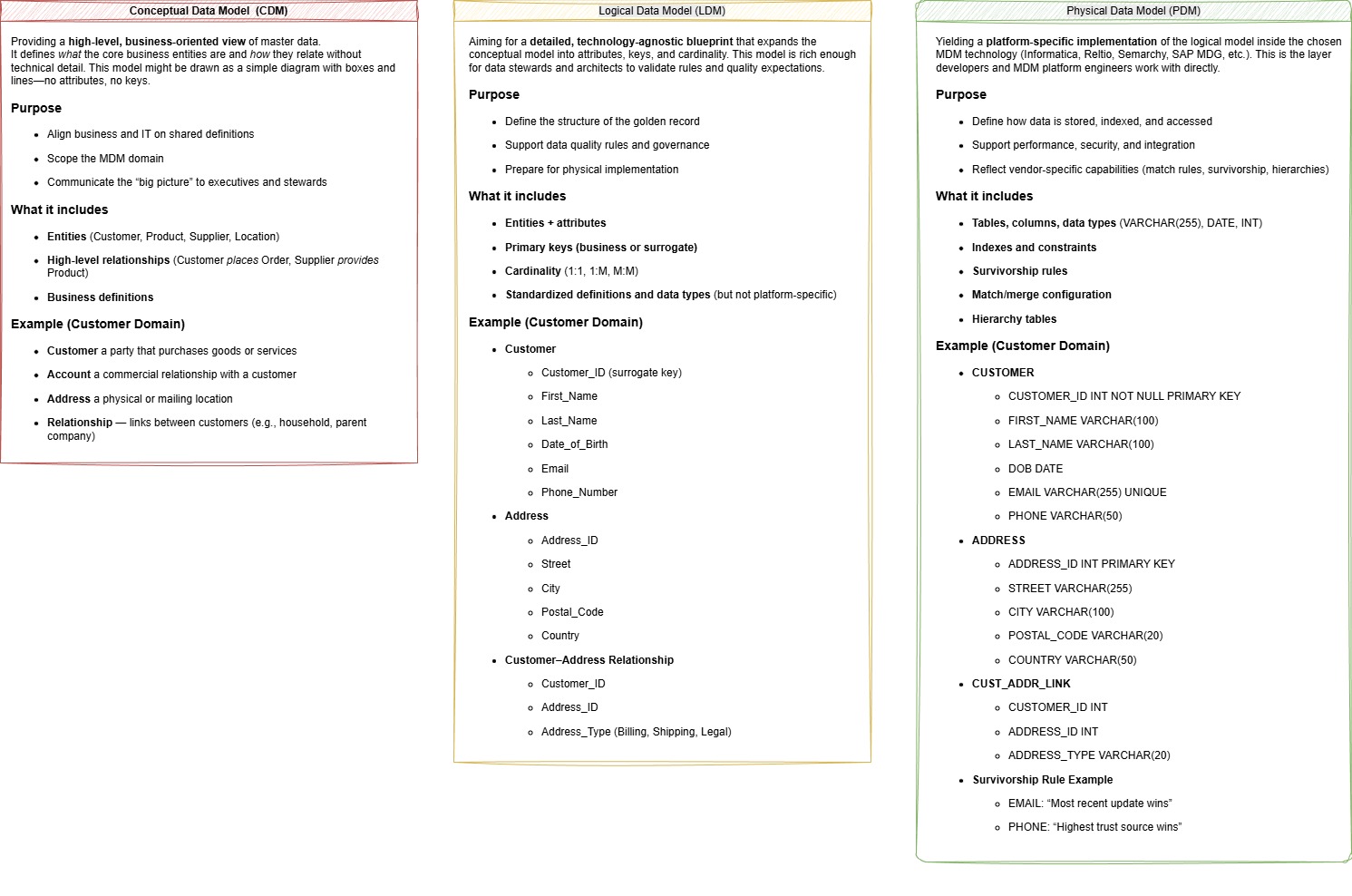
Master data model designs
Master data model design is meant to bring clarity. Yet in many organizations the three layers of the model, conceptual, logical, and physical, are blended together until no one is entirely sure what they are looking at. Executives are shown diagrams packed with attributes and keys. Architects debate table structures before the business has agreed…
-
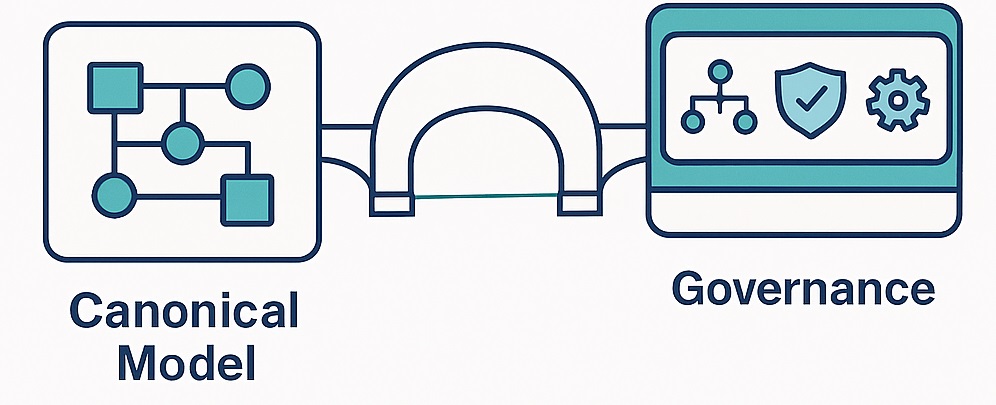
Transforming Canonical Models from Diagrams into Value Through Governance
Canonical models bring clarity and structure to a complex enterprise. They give the organization a common language and a shared semantic foundation. But they are only valuable when supported by strong governance and well-executed Master Data Management. Governance which ensures unified representation of business concepts, reduce integration complexity, and provide a shared language across an…
-

When No One Raises Their Hand
Not every organisation has a leader eagerly waiting to champion an MDM initiative. In fact, in many companies, no one raises their hand. Not because the problems don’t exist — but because the problems have become invisible or politically dangerous. When people live with broken data long enough, it stops feeling like a problem and…
-

Launch an Effective MDM Program
Why agility, focus, and the right partnerships matter more than ever Master Data Management (MDM) never loses its relevance. Organisations are increasingly finding themselves confronted with the fragility of their data foundations. Supply chain disruptions, rapid digital transformation, and the growing need for real‑time decision‑making have pushed MDM to the forefront as a strategic priority.…
-
Reference data, Reference data and…
Reference data is boring, yet it is incredibly important. On its own, it looks like endless tables, codes, and spreadsheets-dry, technical, and easy to ignore. But behind the scenes, it is the foundation of every accurate report, every reliable decision, and every credible ESG claim. Without reference data, a factory is just a name, a supplier is…
-
Reference Data: The Backbone of Reliable ESG Reporting
I’ll admit it upfront, reference data sounds like one of the driest topics imaginable, and it is. It has the same ring to it as filing cabinets, grey spreadsheets, and meetings that should have been emails. If you ever wanted to drain the energy out of a room, just put “Reference Data Governance” on a…
-
Data Classification
Data classification is widely recognised as a prerequisite for effective information governance, yet it consistently underdelivers in practice. The issue is rarely a lack of intent or policy. Instead, organisations struggle with unclear ownership, insufficient enablement, and classification models that fail to align with how work is actually performed. This paper outlines why many data…