Category: Master Data Management
-
Reference data, Reference data and…
Reference data is boring, yet it is incredibly important. On its own, it looks like endless tables, codes, and spreadsheets-dry, technical, and easy to ignore. But behind the scenes, it is the foundation of every accurate report, every reliable decision, and every credible ESG claim. Without reference data, a factory is just a name, a supplier is…
-
Reference Data: The Backbone of Reliable ESG Reporting
I’ll admit it upfront, reference data sounds like one of the driest topics imaginable, and it is. It has the same ring to it as filing cabinets, grey spreadsheets, and meetings that should have been emails. If you ever wanted to drain the energy out of a room, just put “Reference Data Governance” on a…
-

Data Classification
Data classification is widely recognised as a prerequisite for effective information governance, yet it consistently underdelivers in practice. The issue is rarely a lack of intent or policy. Instead, organisations struggle with unclear ownership, insufficient enablement, and classification models that fail to align with how work is actually performed. This paper outlines why many data…
-

When Errors Teach: Building Learning into Your Data Processes
I’ve seen it too often. A data error pops up. Someone fixes it. The report works again. Everyone moves on. Nothing changes. This post aims to make Errors Teach, Building Learning into Your Data Processes. Fixing data is necessary, but it is not enough. If we stop at corrections, we miss an opportunity to learn…
-

Focusing Effort Where Process Failure Hurts Most
I have experienced many orginisations, where governance is treated as a box to tick. Committees are formed, roles are defined, frameworks deployed. Yet despite the structure, data problems persist. Why? Because governance often overlooks the realities of how work actually happens. Governance is not about committees, frameworks, or endless policies. It’s about protecting the business…
-
Embedded Quality Gates: Making Quality Embedded, Not Inspected
Putting a “data quality” check at the end of a process is asking for trouble. It is like building a system designed to create the most problems and making sure we get stuck in them. Waiting until a report is wrong, a handover fails, or an integration breaks is like discovering a leak after the…
-
Process-centric thinking makes failure visible
In my previous post i briefly highlighted anti-pattern, the identification of such is really powerful, and helps to avoid where a solution that looks right, feels responsible, and is often widely accepted, but repeatedly produces poor results. Seen inside business processes, at the moments where data is created, changed, handed over, or relied upon, something…
-
Why governance patterns live in process
In my previous two posts (Process centric thinking for data governance and from process awareness to process driven governance), I argued that data governance only becomes meaningful when we see it through the lens of business processes, those moments where data is created, changed, handed over, and relied upon. Process-centric thinking reveals something important. Most…
-

From Process Awareness to Process-Driven Governance: Making It Real
Seeing data through the lens of process reveals dependency, accountability, and impact. But value only materialises when that perspective is embedded in how people work, decide, and improve every day. Process-centric thinking is not a destination. It is a way of seeing organisational reality, and from that perspective, shaping governance that actually changes outcomes. So,…
-
Process-Centric Thinking for Data Governance
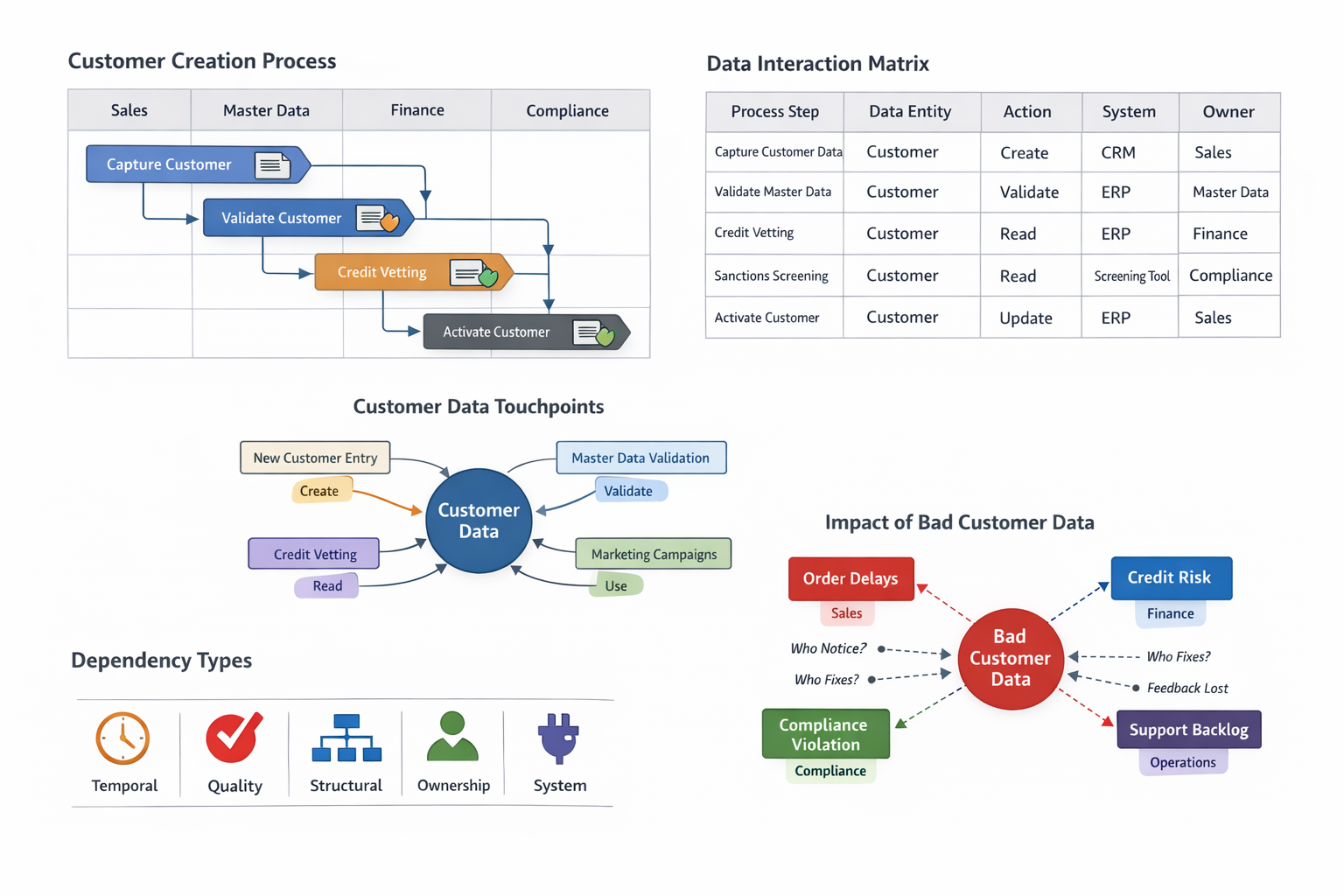
In my previous post, I argued that Critical Data Elements are not defined by importance. They are defined by process dependency. Data does not become critical because it exists or because it sounds important. It becomes critical because something in the business breaks when it is wrong, late, missing, or ambiguous. That insight exposes a…