Category: Master Data Management
-

Clear roles. Stronger governance. Better data.
Data governance often fails not because organizations lack policies or tools, but because nobody is quite sure who is supposed to do what. A data quality issue surfaces, and three teams point at each other. A new data product needs an owner, and the request stalls in email threads. A security exception is requested, and…
-

Where Medallion Architecture and Canonical Models Actually Meet
Medallion architecture has become the default mental model for organizing a data platform: land raw data in Bronze, clean and conform it in Silver, serve trusted, business-ready data from Gold. It’s simple, it’s intuitive, and it works, right up until three teams build three different “customer” tables and nobody can agree on the number in…
-

Distributed Attribute Ownership Specification – Template
What this describes: how ownership/responsibility for a single data attribute is distributed across multiple parties, and how that responsibility hands off as the attribute (or its governing lifecycle) moves through states. Fill in every ‹ › placeholder. Delete the guidance notes when done. 1. Identity Field Value Attribute ‹name of the attribute being governed› Type / shape ‹e.g.…
-
Data Contract – Template
How to use this. A data contract is an agreement between the people who produce a dataset and the people who consume it. It exists to replace assumption with accountability, not to generate paperwork. Fill the Minimum Viable Contract (sections 1–5) for every governed dataset. Add sections 6–9 only when the data’s scale, risk, or number of consumers…
-

From Data Responsibility to Trust
Let us get real. Most companies talk a big game about data platforms, self-service analytics, and unlocking the potential of data. Then complicated topics like PII enter the scene, creating chaos or prompting many to turn a blind eye to the problem. This is why the role of a data platform owner is critical. Without…
-
Critical Data Elements
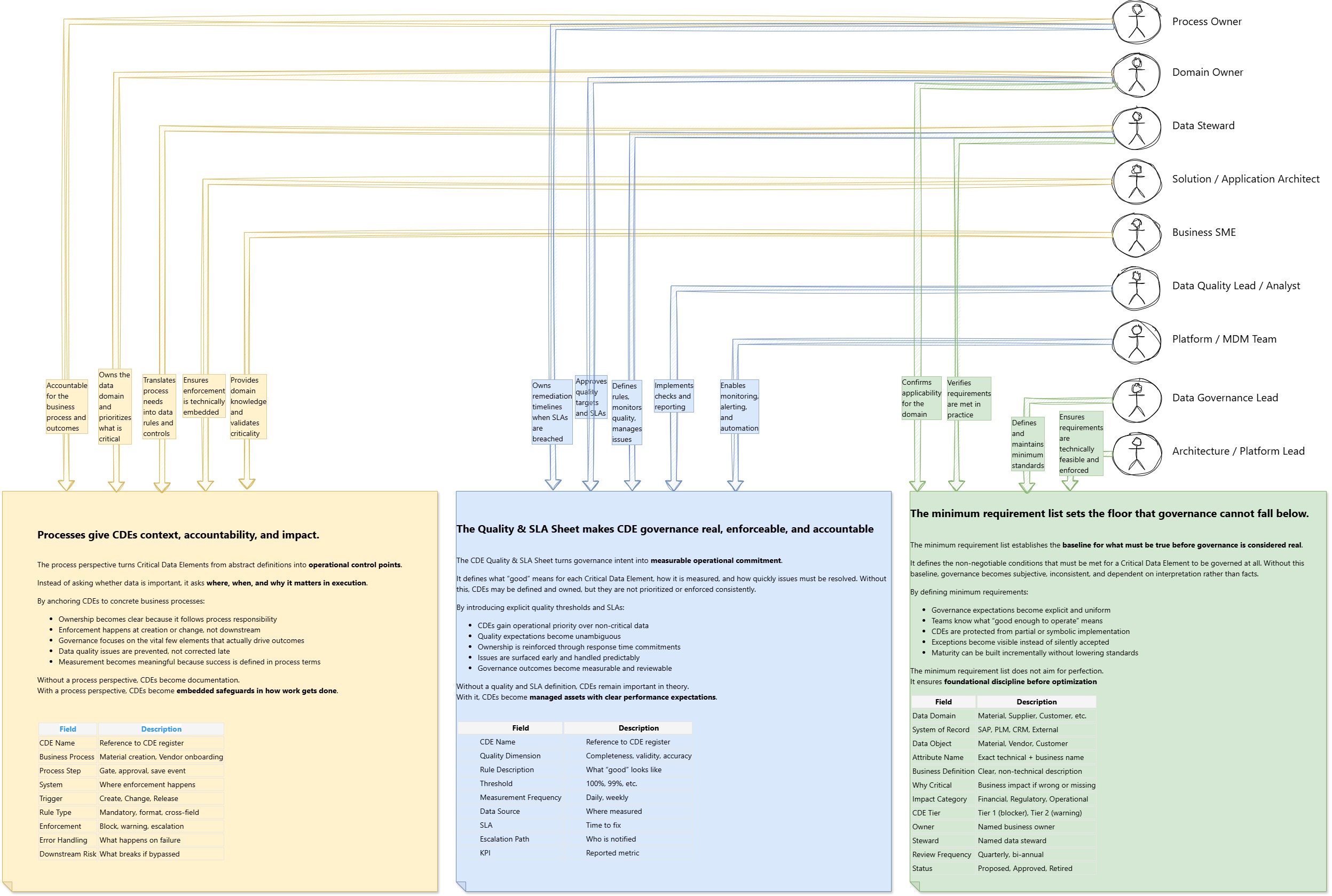
This time, I am focusing on Critical Data Elements and, more importantly, the perspectives through which they must be understood. CDEs are not valuable on their own. Their value emerges only when they are placed in the right context, tied to business processes, and supported by clear roles that both contribute to and rely on…
-

Master Data Management Platform Selection
From Tool Evaluation to Operating Model Alignment Selecting a Master Data Management (MDM) platform is often framed as a technology decision. In practice, it is far more consequential. The choice of MDM platform implicitly defines how data governance is executed, how business processes are enforced, and how complexity is managed across the enterprise landscape. This…
-
A Double Edged Sword
In modern IT organizations, compartmentalization is the practice of dividing responsibilities, systems, or data domains into clearly separated units. This approach can be incredibly helpful when it brings clarity, control, and protection. It can also create problems when it interferes with collaboration or end to end visibility. Nowhere is this balance more important than in…
-

Artificial Intelligence Isn’t Intelligent
I’m tired of having to pretend that “Artificial Intelligence” is anything close to intelligent. Every day, I watch the hype grow louder, the expectations rise higher, and leaders talk about AI like it’s some sort of digital oracle , a wise machine that understands the world and will magically fix all the problems they don’t…
-
The Unrealistic Promises of AI for Master Data
AI in MDM • Data Governance • Data Quality • Enterprise Data Management For the last two years, the technology world has been obsessed with one idea: AI will change everything. But as with many tech promises, reality is far behind the hype. And if there is one discipline where the promises are loudest, the…