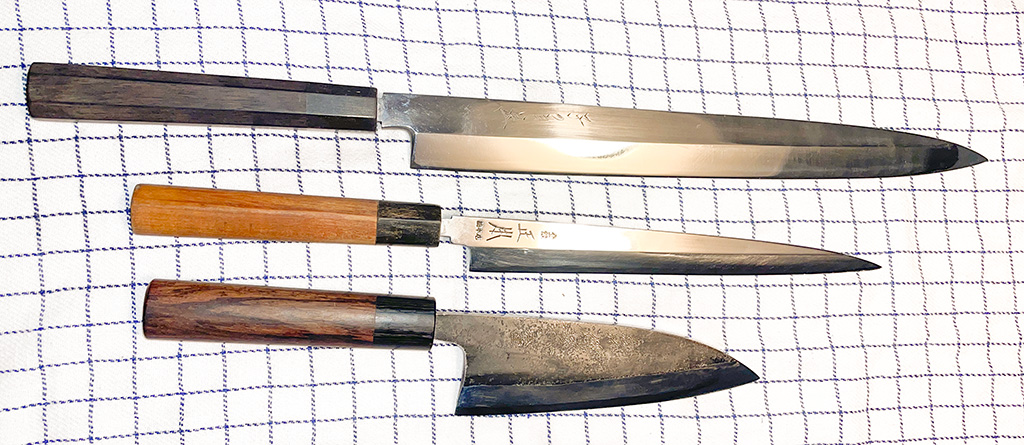
In Japan, gifting a knife can symbolize cutting ties, which might be seen as negative. To counteract this, it’s traditional to include a small coin with the knife. The recipient can then “buy” the knife from you by returning the coin, which is believed to cancel out any ill intentions.
Suggested listening : https://www.youtube.com/watch?v=hejQ4D6lg8M
Using a Japanese knife is much more than simply a means to an end in the kitchen; it’s a practice rooted in centuries of tradition, craftsmanship, and respect. Each blade tells a story of generations of artisans dedicated to perfecting their craft, and the way we use and care for these knives honors that legacy. The precision, care, and reverence we give to a Japanese knife impact not only its performance but its longevity, ensuring that it outlasts its owner and continues to serve for decades to come.
Use a pinch grip for control and stability. Pinch the blade between your thumb and the side of your index finger, just above the bolster, while wrapping the rest of your fingers around the handle. Having a direct connection to the cutting edge, allowing for more nuanced movements is particularly useful for intricate cuts like mincing, filleting, or finely slicing. For smaller knives, a simple grip on the handle with the fingers wrapping around it can work as well.
For knives like a Santoku or Gyuto, use a rocking motion rather than a simple up-and-down chop. This utilizes the curved blade and helps with smoother cuts. For Nakiris or other straight-edged knives, apply a push-cutting technique by guiding the blade forward and downward in a straight motion. The excellence is in the thin, precise cuts, never force the knife, let the sharp edge do the work.
The material of your cutting board plays a huge role in how it interacts with your knife. Hinoki wood (Japanese cypress) is the traditional material for high-quality Japanese cutting boards. It’s soft, gentle on the knife edge, and resists deep grooves, helping to maintain your knife’s sharpness. The aroma of hinoki also adds a pleasant sensory experience. However, hinoki can be expensive and requires maintenance to prevent cracking and drying out.
Leave a Reply