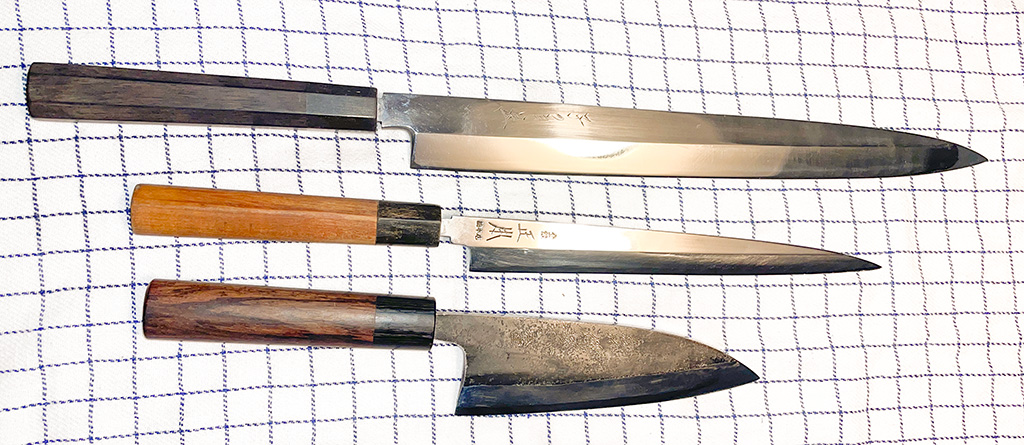
What makes a great knife, and is the extra cost of a Japanese blade justified? At first glance, it might seem counterintuitive to choose a steel that’s more prone to rust over a durable, low-maintenance industrial knife from brands like Victorinox, Wüsthof, or Zwilling. These Western knives offer solid performance, withstand heavy use, and require less upkeep.
Suggested listening : https://www.youtube.com/watch?v=Os47nMrjw_Y
However, Japanese knives; especially those forged from high-carbon steels like Aogami (青紙 Blue Paper Steel) or Shirogami (白紙 white steel); offer something different: unmatched sharpness, precision, and edge retention. Beyond that, their weight distribution is superior, often balancing closer to the hand for better control and finesse in cutting.
Not for the Gullible
Japanese knives aren’t for those who believe a knife should handle anything thrown at it. These blades are specialized tools, not all-purpose workhorses. The same hardness that gives them incredible sharpness also makes them fragile. Use them for tasks beyond their intended purpose; like hacking through bones, twisting in hard vegetables, or prying things open; and you’ll quickly find yourself with a chipped or broken edge.
Buying Second-Hand & Restoring
The high cost of a quality Japanese knife makes it tempting to look for second-hand options. Many traditional knives can last a lifetime; sometimes even longer; if properly cared for. A well-used blade with good steel can often be restored by a master sharpener, bringing it back to near-new condition.
If you go this route, look for knives with minimal chipping and no major structural damage. Avoid anything with deep rust, severe bends, or excessive thinning from improper sharpening. A skilled sharpener can fix minor imperfections, re-profile the edge, and even remove small chips, giving you a high-end knife at a fraction of the price.
Just like with any finely crafted tool, a well-maintained Japanese knife, whether new or restored, is an investment in function esthetics and beauty; not just in steel; and in the experience of cutting itself.
Aesthetics & Craftsmanship
Owning a Japanese knife isn’t just about function; it’s also about craftsmanship. Many of these knives are hand-forged by skilled artisans, with techniques passed down through generations. The blade geometry, the careful tempering of the steel, and the fine polishing of the edge all contribute to something beyond just a cutting tool. Some knives even bear the hammered tsuchime (槌目) texture, how ever i do perfer a traditional Kasumi finishes that make them as beautiful as they are effective.
Even the handle is a work of art, often crafted from fine woods like magnolia, ebony, or even stabilized burl, providing a comfortable and natural grip. The attention to detail in balance and aesthetics makes using a Japanese knife an experience rather than just a task.
Leave a Reply