First and foremost, I am a photography hobbyist. The solution I chose may not suit every professional photographer, although the underlying principles can scale to a business environment.
A few years ago, several portable hard drives failed. The loss was not replaceable. I was fortunate to recover a few photographs I had previously sent to friends and family, including pictures from when our daughter was born. It was a painful lesson, and since then I have taken photo storage much more seriously.
Stop for a moment and consider what would happen if your main hard drive failed, your computer was stolen or another disaster struck. Would your photographs still be safe? You might rely on manually copying images to an external drive and storing it somewhere else, but how often do you do that? How much time does it take, and how will the process scale as your RAW files and photo library grow?
Looking for a solution
I identified four requirements for a storage solution:
- Accessibility: Access to photographs from devices on the home network and, where appropriate, remotely.
- Security: Protection against drive failure, theft, accidental deletion and unauthorised access.
- Sharing: A convenient way to share selected photographs with family and friends.
- Scalability: Enough capacity to grow without constantly running out of space.
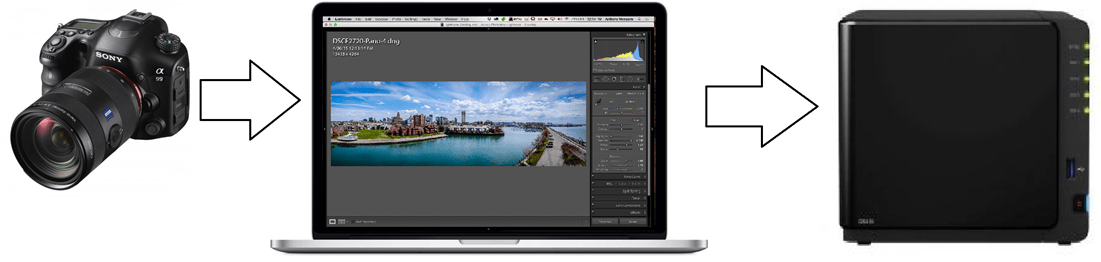
A network-attached storage system (NAS) seemed like the best fit. There were products at several price points, with different features and levels of complexity. After reading reviews and recommendations, I chose Synology. I found it robust and feature-rich, while still accessible to a home user.
Hindsight is a wonderful thing
I chose a Synology DS710+, which was not a bad decision at the time. It had a capable Atom processor and a reasonable amount of memory, but only two drive bays. Initially, two 3TB drives seemed like more storage than I would ever need. That feeling did not last long, particularly once I considered the capacity used by redundancy and the growth of RAW files.
Accessibility
Synology made it straightforward to create links to files and folders. Its QuickConnect service also provided remote access without requiring me to make complex changes to my router. The applications available at the time made it easy to connect from Android, iOS, Windows, Mac and Linux devices. I could also access the library from a compatible Samsung television.
Security and backup
RAID provided protection against certain drive failures, but it was important to understand its limitations. RAID is not a backup. It does not protect against theft, fire, accidental deletion, ransomware or damage to the NAS itself.
I therefore combined local storage with off-site backup services. At the time, I used services such as CrashPlan and Amazon storage. The specific products and service plans have changed since then, but the principle remains important: keep a separate copy of your photographs in another location, and make sure you can restore it.
Synology also provided a Security Advisor tool. I recommend using the security features available on your NAS, keeping the software updated, using strong unique passwords and enabling multi-factor authentication where supported. Exposing a NAS directly to the Internet increases risk, so remote access should be configured carefully.
Sharing
Synology’s Photo Station package made it easy to create galleries and share selected photographs. Permissions could be applied to particular albums, which was useful when I wanted to share images with specific people rather than making the whole library public. The package also offered companion applications and tools for organising photographs.
Scalability
Looking back, I should probably have chosen the four-bay model rather than the two-bay DS710+. The extra drive bays would have given me more flexibility as the library grew. Storage capacity is not simply the sum of the drive sizes, particularly when using RAID or another redundancy arrangement.
All in all, a NAS combined with a proper off-site backup strategy has worked well for me. The important lesson is not to rely on a single device or a single copy of your photographs. Protect the originals, keep a separate backup away from the house and test that you can restore your files.
Historical note: This article describes a Synology DS710+ and software available around 2015. Synology products, applications and cloud-backup services have changed. Check current compatibility, security guidance and backup options before following any specific product advice.


Leave a Reply