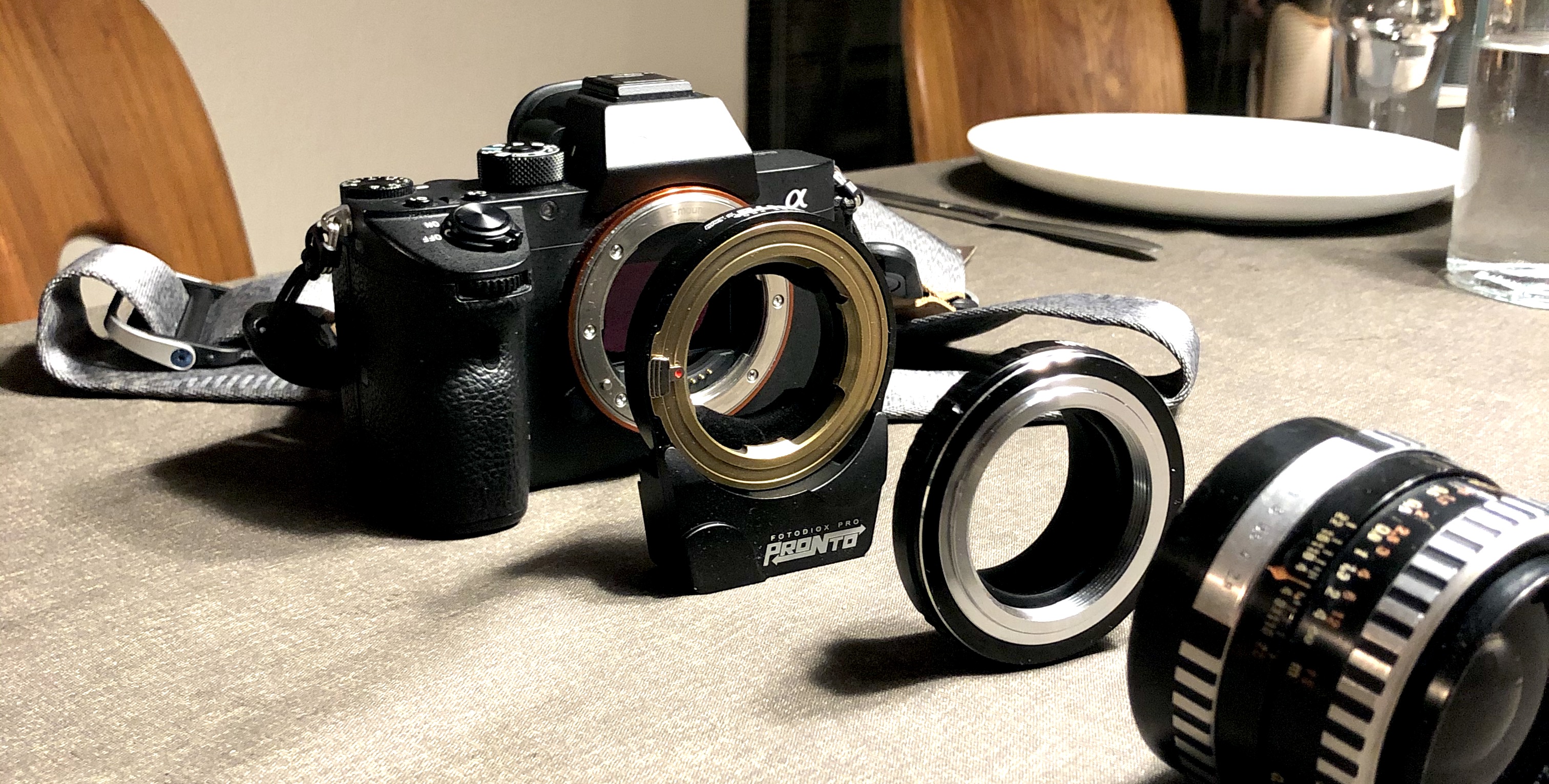
Autofocus with an old manual lens sounds intriguing, does it not? There are plenty of opinions about these adapters, ranging from warnings about compatibility and mechanical stress to enthusiastic claims that they work perfectly. I wanted to understand what they could actually do in practice.
At the time, two products attracted my attention: the Techart LM-EA7 and the Fotodiox Pro Pronto. The Pronto was available for Sony E-mount and Fujifilm systems. Product availability and compatibility may have changed since this article was written.


How the helicoid adapter works
These adapters use a motorised extension mechanism. Moving the adapter changes the distance between the lens and the camera sensor, allowing the camera to adjust focus even though the lens itself has no autofocus motor. The available extension is limited, so the lens often needs to be pre-focused within a suitable range.


Autofocus performance
In my tests, the system worked surprisingly well, but there were important limitations. Performance depended on the camera body, lens, adapter firmware and the amount of focus adjustment required. With my Sony A7R III, phase-detection autofocus worked well in some situations, and I was able to use face and eye detection. However, the adapter did not provide the same experience as a native autofocus lens.
I tried three lenses: the Helios-40-1 85mm f/1.5, the Meyer-Optik Görlitz Orestor 135mm f/2.8 and the Carl Zeiss Jena Pancolar 50mm f/1.8. The 50mm lens worked relatively smoothly. The longer lenses often needed to be pre-focused close to the subject before the adapter could complete the adjustment. Eye detection could also be less precise than it appeared in the viewfinder.
Some lens designs, including those with floating elements, may not be suitable. Check the adapter manufacturer’s compatibility information for the exact lens and camera combination.

Camera aperture settings and adapter control
One unusual aspect of the workflow was that the aperture value selected on the camera could be used to control adapter behaviour, even though the adapter did not physically control the lens aperture. The mapping of values to adapter positions was specific to the product and firmware version. The original article included the following settings for my setup:
- f/11: 15mm
- f/13: 18mm
- f/14: 21mm
- f/16: 24mm
- f/18: 25mm
- f/20: 28mm
- f/22: 35mm
- f/25: 50mm
- f/29: 90mm
- f/32: 135mm
- f/36: minimum extension (infinity position)
- f/40: maximum extension (closest focus)
- f/45: hold the current extension
These values are not universal and should not be copied to a different adapter or firmware version. Consult the current manual for your own equipment.
Build quality and handling
The adapter felt compact and well made, with a metal exterior and tight tolerances. However, it protruded below the base of my Sony A7R III, which could interfere with some tripod plates and quick-release systems.
Firmware and support
I updated the firmware on my Pronto Pro using the manufacturer’s app. The update improved compatibility with my A7R III and made autofocus feel slightly more responsive. Firmware support is an important consideration with these products, so check whether updates and documentation are still available before buying second-hand.
Conclusion
These adapters offer an unusual way to bring autofocus functionality to manual lenses. In the right circumstances, the result can be useful, particularly for subjects that move slowly enough for the adapter to keep up. They do not turn every vintage lens into a modern autofocus lens, and there are limitations around focus range, compatibility and reliability.
For me, the adapter was an interesting experiment rather than a permanent part of my kit. I enjoy the deliberate process of using manual lenses, and autofocus took away some of that appeal. If convenience is more important to you, the adapter may be worth exploring, provided you check compatibility carefully.
Historical note: This is a review of products and firmware available around 2020. Confirm current compatibility, support and availability before purchasing.

Leave a Reply